Blog
The Biology of Becoming, Part V: Growth Mindset, or Learning to Surf
Growth mindset does not exist in isolation. It thrives in environments where these forms of wealth – time, energy, attention and money – a...
Growth mindset does not exist in isolation. It thrives in environments where these forms of wealth – time, energy, attention and money – are protected and balanced.
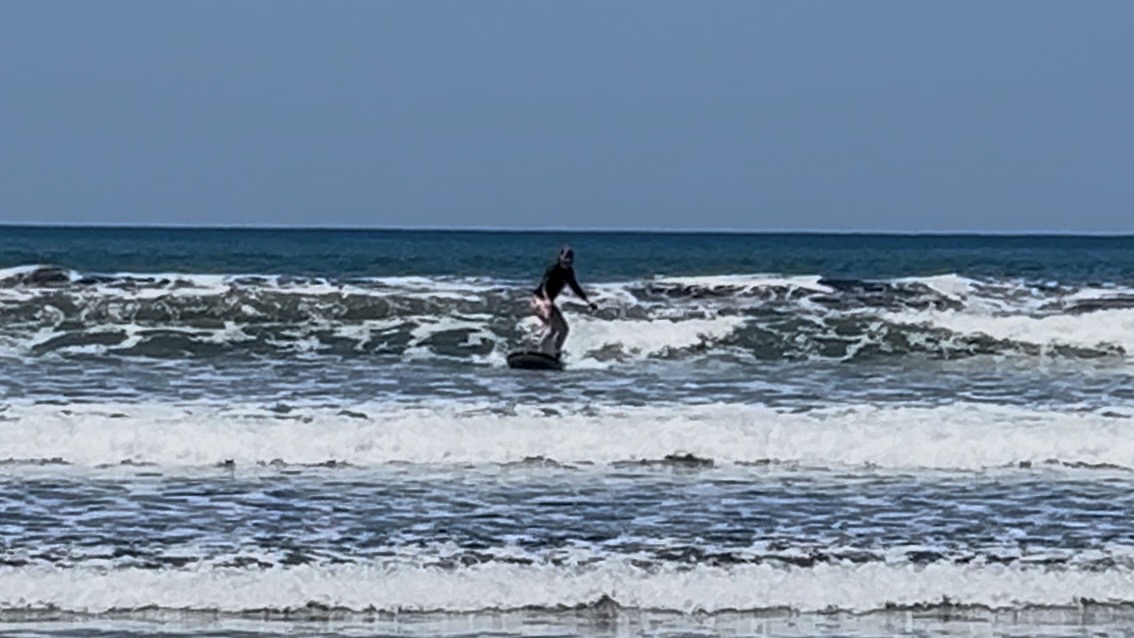
When this piece is published, I will have recently returned from Costa Rica, where for the last 15 years, I have invested time learning – sometimes gracefully and sometimes rather unceremoniously – to surf.
Surfing is not a sport that flatters beginners, and certainly not beginners who have spent most of their lives pursuing competence in other domains where muscle memory and experience already carry a fair amount of weight.
In surfing, the ocean doesn’t care what else you are good at. The wave rises, the timing must be exact, the board wobbles beneath your feet, and more often than not you are reminded quite forcefully that balance is something earned through repetition and respect rather than intention. You also learn who is really in charge here, and it’s the biggest badass queen of them all: Mother Nature.
And yet something interesting happens after a few days. Even though it had been a couple of years since my last time on the water, my body begins to recall movement patterns and effective ways to trade energy with the ocean. Paddling becomes more efficient. The moment when the wave lifts the board becomes slightly more familiar, and my ability to read the waves comes back online, like “hey, old friend.” And when the time comes to stand, there is a subtle but unmistakable improvement in the speed and steadiness with which I pop up.
The wave has not changed, but my nervous system has.
These quiet transformations – small, cumulative, and almost invisible in the moment – are what we are really talking about when we talk about growth mindset. Not the motivational poster version of it, not the tidy phrase that gets tossed around leadership seminars and educational conferences. Instead, it is the biological reality that the human brain is capable of reshaping itself through experience, provided we stay engaged with the process long enough for rewiring to occur.
And that, as it turns out, is not always easy. But it is inherently human.
For years, growth mindset has been discussed as if it were primarily an attitude problem, a matter of optimism or confidence or belief in one’s own potential. If you simply told yourself that you could improve, the story goes, improvement would somehow follow.
But the more time I spend observing people in business, in athletics, in family systems, and increasingly in conversations about money and the emotional narratives that surround it, the more convinced I become that growth mindset is not fundamentally about positivity. Rather, it is about staying in the learning loop.
The learning loop has a rhythm that looks something like this: effort followed by feedback, followed by adjustment, followed by repetition, followed by a gradual increase in competence that only becomes obvious in hindsight. (Remember the Staples “EASY” button from a few years back? THAT was easy. Yeah, like that.) It wasn’t until around 2015, when I really got into CrossFit, that I realized this “positive feedback loop” of skill development was a mad skill with huge translation potential to every part of my life.
Neuroscientists describe this process as neuroplasticity, the brain’s ability to reorganize itself by forming new neural connections in response to experience. The phrase sounds technical, but the principle is elegantly simple. When we practice something repeatedly – whether it is a physical skill, a cognitive pattern, or even an emotional response – the neurons involved in that activity begin to strengthen their connections with one another. Over time, what once felt effortful becomes automatic.
You see this in athletes when a complex movement becomes fluid, in musicians when a piece of music begins to play itself through their fingers, and in investors when years of observing markets gradually produce an intuitive confidence that if the allocations were well-made in the first place, no move is actually the best move. The wave that once knocked you down becomes the wave you can ride. But this transformation rarely happens without some form of struggle first, and struggle has a way of making people question whether they belong in the game at all.
Which is once again where the stories we tell ourselves become important.
One of my favourite illustrations of growth mindset comes not from neuroscience, but from a much older narrative: the story of The Sword in the Stone.
Most people remember the climactic moment when Arthur pulls the sword from the stone and is revealed as the rightful king. But to me at least, as someone who has always gravitated towards shapeshifters in any kind of story ancient or otherwise, that moment is not actually the most interesting part of the story.
The more intriguing section occurs earlier, when Merlin takes Arthur under his wing as a young boy and begins teaching him not through lectures or commandments, but through a series of transformations. Merlin turns Arthur into animals – a fish, a bird, a squirrel – allowing him to experience the world from perspectives he would never otherwise meet. I often think this must be why I pushed myself to explore limits as a business owner, as a creative and also as an athlete. It was my chance at learning who I am at my limits, through shapeshifting.
As a fish, Arthur learns about currents and movement beneath the surface. As a bird, he learns about navigation and what there is to be gained by pulling up to a higher perspective. As a small creature among larger predators, he learns about vulnerability and caution, and that even tiny has its advantages. In each case, Arthur is not simply told how the world works – he gets to experience it from within a different nervous system.
And that is precisely how human learning tends to occur. We develop competence not through abstract knowledge alone but through experiences that stretch the boundaries of what our bodies and minds have previously known how to do. (To this day, my father laughingly recalls when I was a teen, and that since then I have referred to myself as an “experiential learner,” which was a kind way of saying I would rather try and fail than have anyone tell me what to do) Every new challenge creates a moment of instability – and it is our experience with instability where new neural pathways form. So then every repetition gradually restores balance, and somewhere along the way, the nervous system begins to adapt. The takeaway? Gravitate towards moments of instability.
Merlin, in other words, was quietly running Arthur through one of the most effective training programs imaginable: start small, expand perspective, increase complexity, and allow the learner to grow into the role that initially felt beyond his capacity. The lesson is beautifully simple: you do not become capable before the challenge, rather, you become capable *through* the challenge.
Long before I ever paddled out into a surf break, I met with this lesson on water of an equally punishing kind: ice. As a competitive figure skater growing up, the majority of my extracurricular life before the age of eighteen was spent in rinks where progress came in increments so small they were almost imperceptible. A jump that seemed impossible on Monday might begin to feel marginally less terrifying by Friday. And the number of times you fell – sometimes spectacularly – vastly outnumbered the moments of clean execution for weeks on end. But my nervous system was paying attention.
The first attempt at a new skill is always clumsy. The second attempt, while far from graceful, often arrives with a tiny spark of knowing. You can see this look on my face even today in my Olympic lifting training videos – “oh heck ya, damn I’m feeling it now.” By the third or fourth attempt, the nervous system begins storing information about balance, timing, and rotation. You pop up a little faster the next time. The jump into the rotation spins you rapidly in the air until the exact moment of inertia that drops you into the stuck landing becomes one flowing movement. Over months and years, these lessons in adaptation accumulate until movements that once required enormous concentration become almost effortless.
Looking back now, I realize that skating was teaching a lesson that would become useful far beyond the rink: progress is rarely dramatic in the moment, but it compounds quietly in the background if we are willing to stay in the process. The gains also got smaller over time as mastery developed, and that’s not a bad thing. That’s what reaching your full human potential looks like.
Growth is not only about effort. Sometimes it’s also about timing. Which is why the fairy tale of The Ugly Duckling remains such a powerful metaphor for the different seasons of human development.
In that story, the duckling spends much of its early life believing it is fundamentally flawed, misunderstood by itself and by the other birds around it. The truth, of course, is that it’s not a duck at all – it’s a swan. And the awkwardness of its early life is simply the result of being in the wrong context at the wrong stage of development.
Human beings pass through similar phases. There are moments in life – adolescence, early adulthood, parenthood, midlife transitions – when our internal biology begins to change faster than our external identities can keep up. What once felt comfortable becomes unfamiliar. The strategies that once worked begin to lose their effectiveness. In those moments, it is easy to interpret discomfort as failure. But I am here to tell you that sometimes, more often than not, discomfort is simply the signal that the system is updating.
Sometimes the nervous system is preparing us for a larger identity that has not yet fully emerged. Growth mindset, in that sense, is less about relentless effort and more about remaining open to transformation, even when the process feels awkward or incomplete.
If adolescence teaches us about experimentation, parenthood tends to teach us about structure.
When my children were young, I quickly discovered that trying to balance professional responsibilities with how present I wanted to be with them required something more reliable than willpower. The competing demands of work and family could easily blur together until neither received the attention it deserved.
So I created a rule for myself.
Every day, regardless of what anyone else thought of me for doing so, I would leave in time to pick up my children from school at three o’clock in the afternoon. Once we were home, the focus shifted entirely to family life – homework, activities, meal prep, dinner, conversation, the ordinary rituals that quietly shape childhood – and let’s be honest, it’s also the good stuff. Only after they were in bed would I reopen the laptop and return to professional responsibilities.
I will also quietly admit here that the advent of the devilish little blue light at the top of the Blackberry was my first tango with the incipient stress that sneaks into your life from notifications. The rules around that took much longer for me to create. A perfect example of a technology that can quietly take over your life.
But the 3 o’clock rule was a simple boundary, and it created a system that protected what mattered most. And systems, it turns out, are one of the most underappreciated tools in cultivating capacity for a growth mindset. When the environment supports our priorities, the nervous system no longer has to negotiate the same decision repeatedly. Energy can be directed toward learning, connection, and creativity rather than internal friction and self-regulation.
This idea connects naturally to the Flourish Framework and the four forms of wealth it describes: time, energy, money, and attention.
Each of these resources influences our ability to grow. Without time, there is no space for experimentation. Without energy, challenges feel overwhelming rather than invigorating. Without financial stability, risk can trigger fear rather than curiosity. And without attention, the feedback loops that drive learning become fragmented and incomplete.
Growth mindset therefore does not exist in isolation. It thrives in environments where these forms of wealth are protected and balanced.
As life progresses, growth often takes on a different shape. Earlier stages may emphasize expansion – acquiring skills, building careers, raising families. But midlife introduces another capacity that is equally important: discernment.
A few years ago I made a decision that surprised many people in my industry. Instead of continuing to expand my wealth practice by adding more and more client families, I chose to reduce the number of wealth families I served. The reason was simple: my definition of success had evolved.
I realized that the quality of the relationships I maintained, the depth of advice I could provide, and the energy I had available to contribute meaningfully to the people and communities around me mattered far more than the sheer scale of the business. In that moment, discernment replaced hustle. And that too is growth, which seems fitting at a stage in life when you’ve seen a few mountain tops and you begin to relish the process more than the peaks.
All of these various superpowers for each life stage are unfolding for different parts of the population at a time when technology – particularly artificial intelligence – is reshaping the landscape in which we learn and work.
AI can generate information at astonishing speed. It can draft emails, summarize research, and automate tasks that once required hours of human effort. But there is one aspect of growth it cannot replicate: it cannot experience the nervous system’s transformation through struggle and adaptation. And the implications of that are so far reaching we will need another chapter to talk about those when it comes to wealth.
AI can provide answers, but the human capacity to become – to grow through effort, feedback, and reflection – remains uniquely ours. And we damn well better grasp how meaningful that is and run hard with it. Because in a world overflowing with information, the most valuable skill may simply be the willingness and capacity to keep learning.
And so we return to the ocean. To the feeling of paddling out once again, watching the horizon for the next set of waves, knowing that some will knock you down and others will carry you forward in ways that feel almost effortless. The ocean does not promise fairness. But it offers endless opportunity for adaptation. Just walking in it tests your ability to thrive on a surface that is moving beneath your feet. Each wave teaches something, every fall provides feedback, and every beautiful ride affirms that the nervous system is capable of learning, far more than we often give it credit for.
And perhaps that is the quiet promise at the heart of growth mindset. Not that life will become easier. But that we can become more capable of meeting it – again and again – until the waves that once frightened us become the ones that carry us home.